Research by Design + Learning by Doing
Williams College
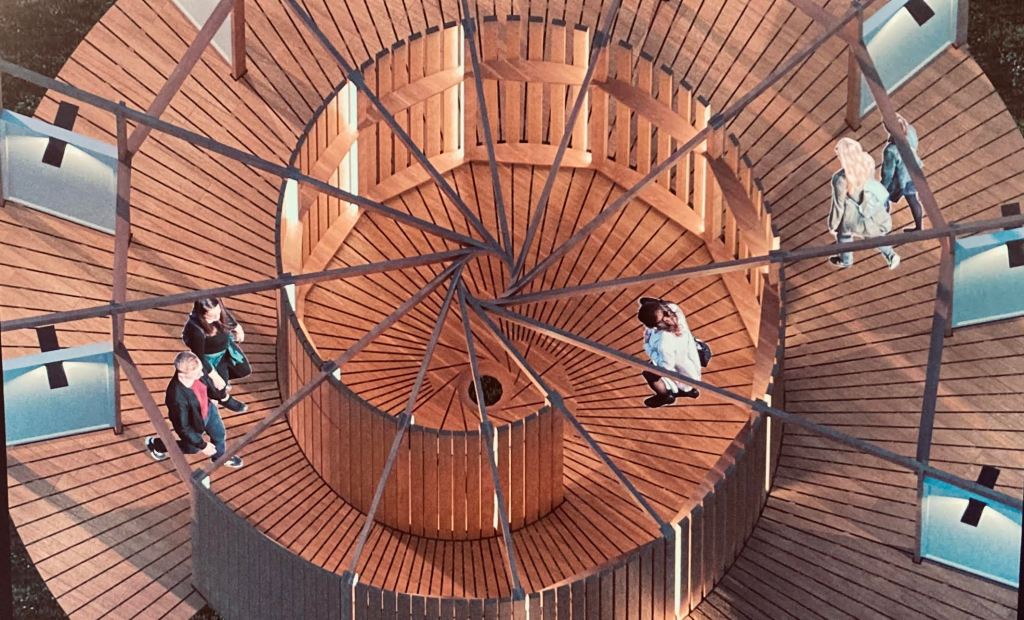
Designed by Williams students in the Fall 2023 “Design for the Pluriverse” tutorial, the Pluriverse Pavilion is a hub for exhibitions, environmental justice discussions, workshops, performances, and meetings. The students wanted it to especially provide a welcoming space for mindfulness and relaxation, promoting holistic well-being where people can relax, study, meditate, or connect.
Grounded in the “pluriverse” concept by Colombian-American anthropologist Arturo Escobar,[1] the Pavilion embraces multiple ways of being in the world, inviting diverse engagement from various Williams communities, individuals, local groups, and beyond.
Bringing together art, architecture, and environmental studies, the Pavilion encourages reflection on the values behind design decisions. It challenges students to consider the impact of extracting architectural materials and urges responsibility in creative work.
This project has given students the opportunity to transform ideas into physical form. It is a hands-on learning experience, bridging theory and practice through what Richard Sennett calls “material consciousness,” connecting intellectual thought with tangible creation.

Reimagining Sustainability
At the heart of the Pavilion project is a commitment to doing things differently, focusing on materials and methods that reflect a deeper engagement with social and environmental issues. Drawing inspiration from scholars like Adrian Parr, Vandana Shiva, and Arturo Escobar, the Pavilion encourages students to rethink what it means to build responsibly in an industry dominated by extractive practices.[2] Every material choice and construction technique is considered not just for its practical or aesthetic qualities but for its broader implications—where it came from, how it was produced, and its impact on people and the environment. While no architecture is non-extractive, the focus shifts to how and why we limit it and how we compensate for it.
The Pavilion calls for a reimagined approach to sustainability, challenging the traditional focus on technological solutions often shaped by economic interests. By welcoming discussions on land reclamation, environmental justice, and the intersections of diversity, inclusion, and belonging, the project seeks to inspire more equitable and inclusive futures. It encourages critical engagement with the root causes of ecological degradation and social inequality, emphasizing the need for systemic changes. These include addressing consumption patterns, social exclusion, resource extraction, and the hidden environmental costs embedded in so-called “green” materials.
[1] Escobar, Arturo. Designs for the Pluriverse: Radical Interdependence, Autonomy, and the Making of Worlds. Duke University Press, 2018. “Pluriverse” refers to various ways of being in the world. The Pavilion employs theories and approaches from design activism and critical environmental studies to analyze the relationship between space and difference, including, but not limited to, race, class, ethnicity, gender, sexuality, religion, and species.
[2] Parr, Adrian. The Wrath of Capital: Neoliberalism and Climate Change Politics. Columbia University Press, 2013; Parr, Adrian. Hijacking Sustainability, MIT Press, 2009; Shiva, Vandana. Earth Democracy: Justice, Sustainability, and Peace. South End Press, 2005.
Key areas of focus of the project include:
1) Examining academic and practical engagements with subversive approaches to sustainability.
- Drawing on the works of scholars such as Adrian Parr, Vandana Shiva, Ozzie Zehner, and Allan Marshall, and incorporating the critical examination of carbon dioxide in architecture, we navigated the controversial meanings of sustainability amid the realities of late capitalism and environmental justice.
- We delved into Arturo Escobar perspective on designing for the pluriverse to propose a transformative approach to sustainability that acknowledges different forms of human and non-human life.
- Each architectural component of the Pavilion is accompanied by labels illustrating its environmental footprint (labor, resources, transportation), along with all the implications of this knowledge.

2) Exploring the dynamics between design and construction, including materials and techniques.
- This exploration is crucial for understanding how designs transition from theoretical models to tangible structures. The diverse properties and capabilities of materials play a crucial role in shaping design choices, significantly impacting aesthetics, durability, and ecological integrity. Techniques, on the other hand, encompass the methodologies and practices employed to manipulate these materials, bringing designs to life.
- The synergy between design and construction, therefore, is not just about the end product but about the process of making informed choices that align with the project’s goals, context, and constraints. This includes considering the environmental impact of materials and techniques and the adaptability of designs to future needs and challenges. By closely examining this dynamic, professionals and students alike can uncover innovative ways to create structures that are not only visually appealing and functional but also responsible and responsive to the ever-changing demands of the built environment.
3) Acquiring essential knowledge in wood construction techniques to contribute to more environmentally friendly buildings.
- Acquiring essential knowledge in wood construction techniques is critical for architects, builders, and designers. This knowledge encompasses an understanding of the properties of different types of wood, how they can be sourced, and the innovative methods by which wood can be utilized in construction to minimize environmental impact.
- Wood construction techniques included the use of renewable wood sources, such as timber from certified forests managed. Additionally, understanding the lifecycle of wood products, from harvesting through manufacturing to disposal or recycling, is crucial for assessing their environmental footprint.
4) Building The Pluriverse Pavilion project at Williams College (dimensions 24′ x 24′ x 12′).
- The Pavilion is set to be displayed on campus for several months. It aims to become a space of engagement and reflection for students, faculty, and the wider community, embodying the College’s commitment to fostering diverse perspectives and dialogues.
- The timeline for the construction and display of the Pavilion was planned to align with academic schedules and seasonal considerations, ensuring maximum accessibility and impact. The process involved close collaboration with students, faculty, and external partners, leveraging a variety of skills from design to construction.
- The Pavilion serves not only as a physical space but also as an educational tool, illustrating the controversial principles of sustainable architecture, the importance of public art, and the value of creating inclusive spaces within the academic community.
 The Pluriverse Pavilion