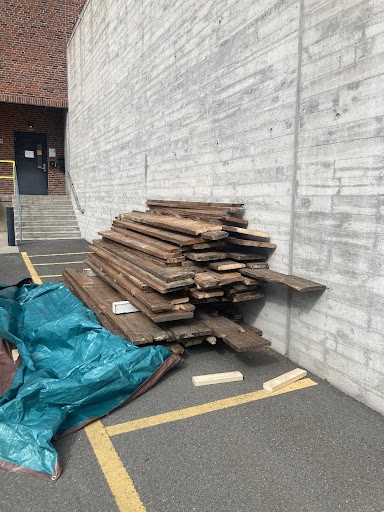
The Pavilion tells a story of materials salvaged and reclaimed and methods rethought. The wood hemlock boards, reclaimed from the refurbishment of the 1895 Jenness House, are more than just structural elements: they carry the history of past uses, now repurposed to support a new project. The exterior panels, reused from a previous Williams exhibition, add continuity and connection, linking past and present initiatives from institutional to student-led project displays.
The information on all architectural components indicating embedded carbon goes beyond mere data; it prompts a more profound reflection on the broader implications of each design choice. This transparency serves as an educational tool: if this small intervention is carbon-negative, it sparks an essential conversation about the environmental impact of larger projects. It encourages students to question whether the most sustainable, non-extractive approach might be to reconsider building anything at all.
Pavilion Total Carbon Footprint: -2066.35 kg CO2e, assuming the structure is disassembled again within one year, that there are no operational uses of carbon-based energy (such as for electricity, heating, cooling, or hot water supply), and using the electricity generation mix for New York state for the carbon footprint of electricity use during assembly and disassembly.[1] The carbon footprint along the main life cycle phases is as follows:
The negative carbon balance of the Manufacturing & Transport of the Pavilion’s materials results from the carbon storage in the wood, the primary material used in the structure. Construction and Installation require energy, resulting in a modest carbon impact of approximately half a metric ton of CO2e, while usage of the Pavilion is assumed to have zero impact because it does not require any new material and/or energy use. The End-of-Life management of the Pavilion is very important. The structure’s demolition and waste disposal in a landfill would result in an estimated 2.48 metric tons of CO2e. This can be substantially reduced if the materials are instead recovered, stored and/or reused in ways that keep the wood intact and thus the sequestered carbon from returning to the atmosphere as carbon dioxide or methane.
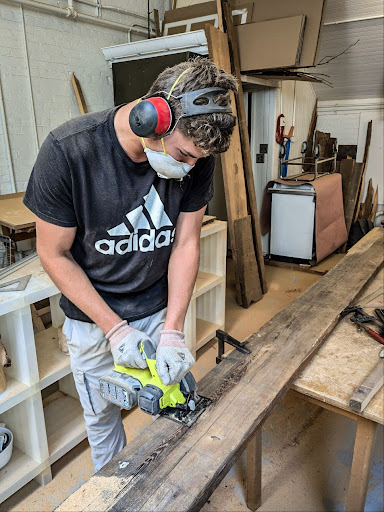
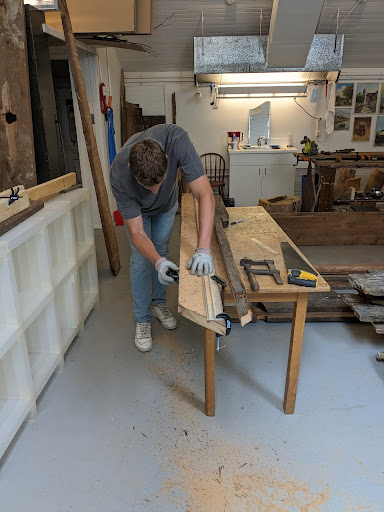
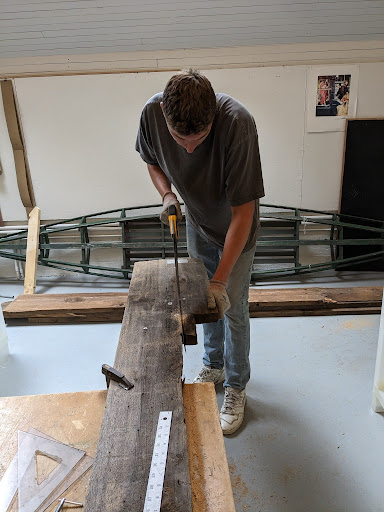
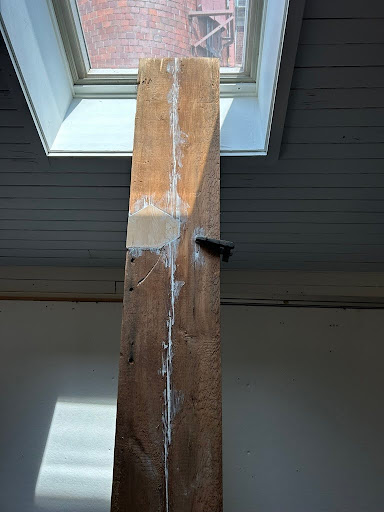
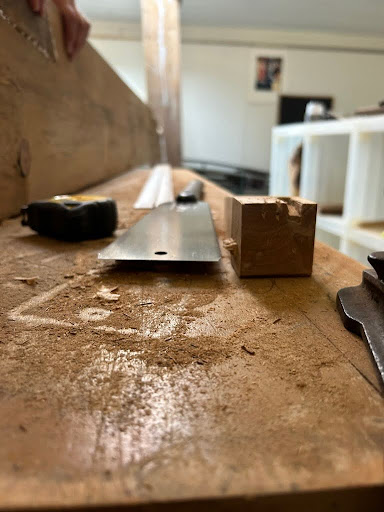
Foundation: The foundation is constructed from 120-year-old Hemlock salvaged from renovations in the Davis Center complex, specifically from the Jenness House (1895). The wood was meticulously cataloged and refurbished, including nail removal, sanding, and patching. These boards form the Pavilion’s structural backbone, while longer, less aesthetic boards were repurposed as sleepers to adapt to unstable grass, facilitate easy removal during deconstruction, and efficiently use materials. Carbon Impact: 424.47 kg CO2e
Floor: The floor is the most carbon-efficient section of the Pavilion, constructed from custom-cut CDX plywood. Assembling like puzzle pieces, it guided the construction process to ensure proper alignment. CNC cut in Hoosick Falls, NY, to minimize transportation emissions, the weather-resistant plywood fulfills its functional purpose. Made by cutting logs into thin slices, this method reduces waste, with the wood veneers dried and glued together. Carbon Impact: -2221.93 kg CO2e
Columns & Beams: The columns and beams are the Pavilion’s heart, embodying historic New England’s character. Their reddish-brown hue, a hallmark of aged Hemlock, sets them apart. Carefully selected for quality and dimensions, these boards exemplify exciting reuse. Their age and condition enhance their strength, making them ideal for maintaining structural integrity. The key question remains: where will they go next?Carbon Impact: -78.21 kg CO2e
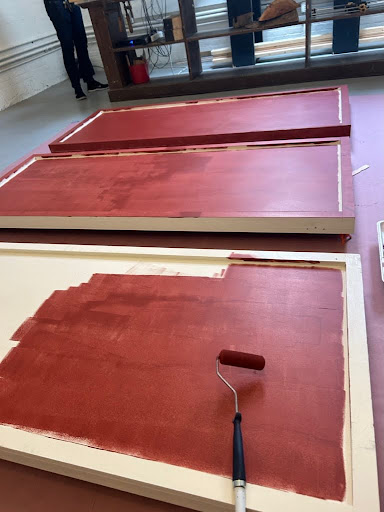
Open-Frame Facade: The vertical studs were sourced from local retailer RK Miles for their North American origin, ensuring sustainable harvesting and reduced transport emissions. The revitalized red panels, reclaimed from a local art installation, serve a similar purpose in their new home, with transport from Lenox, Massachusetts, being their only carbon impact. Carbon Impact: +118.38 kg CO2e
Roof: Custom CNC cut in Hoosick Falls and roughly a fourth of the size of the floor, the roof is treated with a weatherproof coating to help the structure reach its intended lifespan. Originally taller, with 10 degrees pitch rather than the current 5 degrees, the roof represented a late-onset design challenge that required one aspect of the structure to change without affecting the structural and design integrity of the rest of the structure. Carbon Impact: -72.30 kg CO2e
[1] Calculation by Tanja Srebotnjak, Executive Director of the Zilkha Center for the Environment, using the Athena Impact Estimator for Life Cycle Assessment (LCA).
 The Pluriverse Pavilion